
Himalpari – What began as a violent clash in Dewanganj, Sunsari, quickly evolved into far more than a local law-and-order issue. It became a serious test of Nepal’s social trust, religious coexistence, and the state’s ability to maintain public security during a rapidly escalating communal crisis.
For the government, the challenge was not simply to arrest those responsible. The greater task was to transform public anger into dialogue, stop the spread of misinformation, prevent retaliatory violence, and rebuild the trust that had begun to erode between communities.
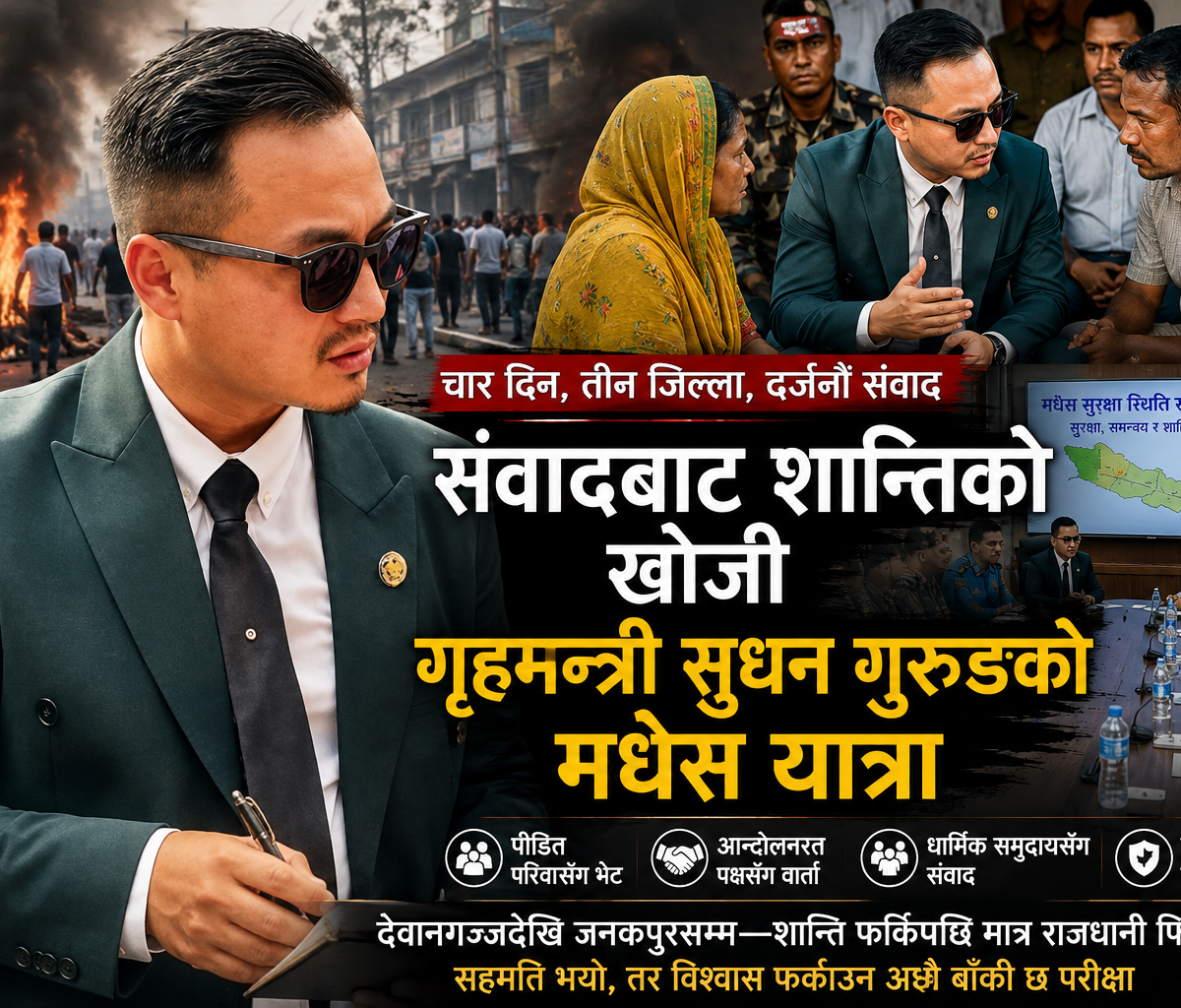
Against this backdrop, Home Minister Sudan Gurung left Kathmandu on July 29 (Shrawan 14) after consulting Prime Minister Balendra Shah. Rather than directing operations from his ministry, he chose to travel directly to the affected districts. Over the following four days, his visit to Sunsari, Siraha and Dhanusha went far beyond a routine inspection. He met grieving families, visited injured victims in hospitals, held discussions with protesting groups, coordinated with security agencies, consulted religious leaders, and worked closely with provincial authorities in an effort to contain the growing unrest.
On the first day, accompanied by Health Minister Nisha Mehta, Gurung travelled to Kaptanganj in Dewanganj-3, Sunsari, where he met the families of Om Prakash Mehta, who was killed during the violence, and Jay Prakash Mehta, who later died while receiving medical treatment. Offering condolences, the government signed a six-point agreement with the victims’ families, committing to an impartial investigation, legal action against those responsible, and the provision of compensation and relief assistance. He later visited hospitals in Biratnagar to check on the condition of the injured and instructed health officials to ensure there were no shortcomings in their treatment.
By then, however, the unrest had spread well beyond Sunsari.
The death of Ganesh Yadav, who was shot during protests in Golbazar, Siraha, had intensified tensions across the region. On the second day, the Home Minister remained in Siraha until late at night, travelling to Aurahi to meet Yadav’s father, Rambriksh Yadav. The government reached another agreement, pledging an impartial investigation, appropriate compensation, free education for family members, and other necessary support. Gurung then convened an emergency security meeting with district administrators, Nepal Police, Armed Police Force officials, and representatives from the National Investigation Department. Authorities were instructed to strengthen security deployments in sensitive areas, increase patrols, and closely monitor rumours that could fuel further violence.
At the same time, the government recognised that restoring order required more than security operations alone. Understanding the public mood and rebuilding confidence had become equally important.
On the third day, Gurung travelled to Janakpur, where religious sensitivities had become increasingly pronounced. He met separately with Hindu, Muslim and other religious leaders, urging restraint, respect for communal harmony, and adherence to the rule of law. During meetings with local administrators, he directed authorities to gradually ease curfew restrictions where appropriate, ensure uninterrupted supplies of food and medicine, and strengthen monitoring of misinformation spreading through social media.
By this stage, the conflict was no longer confined to the streets. Security agencies concluded that unverified information, edited videos, and misleading online content were increasingly being used to portray local incidents as wider religious and communal confrontations. As a result, managing information became an essential part of the government’s overall security strategy.
On the fourth day, Gurung held lengthy discussions with representatives of the Hindu Samrat Sena in Dhanusha. Although no formal written agreement was signed, both sides reached a verbal understanding that led the organisation to withdraw its protest programmes. The Home Minister assured participants that the commitments made during the discussions would be implemented after his return to Kathmandu. He also met Madhesh Province’s Chief Minister, where both provincial and federal authorities agreed to strengthen coordination and increase security monitoring in sensitive districts including Rupandehi, Banke, Saptari, Rautahat and Parsa.
Throughout the visit, Gurung maintained that he would not return to Kathmandu until the situation had substantially stabilised. Only after agreements had been reached in Sunsari, Siraha and Dhanusha, protests had begun to subside, and local authorities reported that the security situation was under control did he return to the capital on August 1 (Shrawan 17) aboard a Buddha Air flight.
The four-day mission delivered a clear message: the government was attempting to address the crisis through more than policing and force. Dialogue, negotiated settlements, political coordination, and direct engagement with communities were given equal importance alongside security measures.
Yet the deeper challenges facing Madhesh remain unresolved.
Communal tension is rarely the product of a single incident. It is shaped by accumulated distrust, political polarisation, misinformation, the misuse of social media, and public doubts about justice. Restoring peace therefore involves much more than ending violence. Whether victims receive justice, perpetrators are prosecuted fairly, and government commitments are genuinely implemented will ultimately determine whether confidence between communities can be rebuilt.
While the government appears to have succeeded in creating an atmosphere conducive to dialogue, the true test is only beginning. Progress in delivering compensation, completing credible investigations, pursuing prosecutions, supporting affected families, and restoring social trust will determine whether this intervention is ultimately judged a success.
The violence that began in Dewanganj has delivered an important lesson for the state: security is not maintained by police presence alone—it is sustained by justice. Curfews may empty the streets, but they cannot remove the fear that lingers in people’s minds. Only transparent investigations, impartial legal processes, and continued dialogue between communities can achieve that.
The government’s four-day intervention may have eased immediate tensions, but lasting peace will depend on how faithfully it fulfils the promises it has made. Madhesh may be calmer today, but trust has not yet been fully restored. The coming months will therefore test not only the government’s capacity to maintain security, but its ability to rebuild confidence in the institutions meant to protect all citizens equally.