
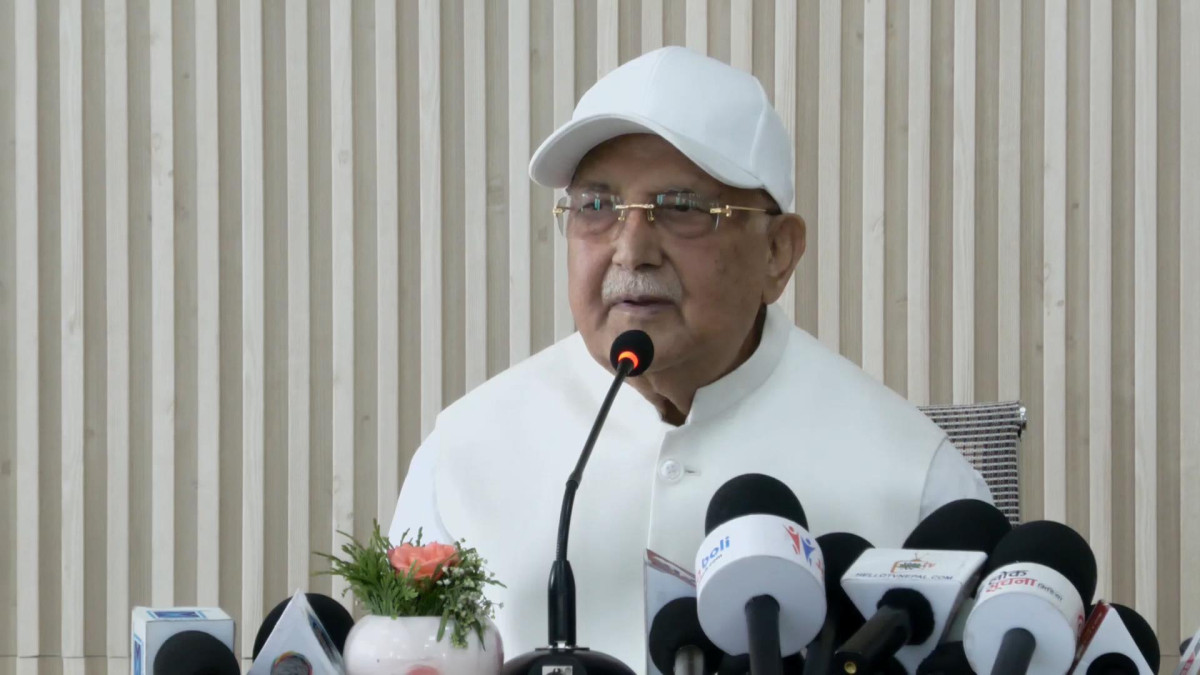
Kathmandu: Former Prime Minister and Chairman of the Communist Party of Nepal (Unified Marxist–Leninist), KP Sharma Oli, has questioned the long-standing official narrative surrounding the 2001 Narayanhiti Royal Palace Massacre, saying there has never been conclusive proof that then Crown Prince Dipendra Shah was responsible for killing the royal family.
Addressing a party programme at the CPN-UML headquarters in Chyasal, Lalitpur, on Friday, Oli claimed that the widely accepted account of the massacre was based on an unverified narrative that spread across the world immediately after the tragedy.
He argued that the story linking the massacre to Crown Prince Dipendra’s alleged love affair was a “ready-made narrative” that was accepted internationally without sufficient investigation.
“On June 1, 2001, the Royal Palace Massacre took place. Immediately afterwards, a story spread across the world claiming that Crown Prince Dipendra, because of a failed love affair, killed his father, mother, brother, sister, uncles, aunts and other members of the royal family before taking his own life,” Oli said.
“That ready-made story dominated public discourse for more than two decades. But the truth has still not been established. We still do not know what actually happened.”
Oli further questioned the origins of the narrative, saying it remains unclear who first created and circulated the story.
“We do not know who authored that version of events or who first presented it. Yet it was accepted and repeated worldwide. Surprisingly, major international media outlets carried the narrative without conducting sufficient independent inquiry into such a significant event. In reality, that information has never been conclusively proven,” he added.
One of Nepal’s Most Mysterious Tragedies
The Narayanhiti Royal Palace Massacre occurred on 1 June 2001 (Jestha 19, 2058 BS), when King Birendra Bir Bikram Shah, Queen Aishwarya, Prince Nirajan, Princess Shruti and several other members of Nepal’s royal family were shot dead inside the Narayanhiti Royal Palace in Kathmandu.
Crown Prince Dipendra was critically injured during the incident and remained in a coma for three days. During that period, he was officially declared King before dying from his injuries.
A high-level investigation committee formed by the then government concluded that Crown Prince Dipendra had opened fire on the royal family before turning the weapon on himself. However, the findings have remained the subject of public debate, speculation and numerous alternative theories over the past two decades, none of which have been officially substantiated.
Oli’s latest remarks have once again brought renewed attention to one of the most controversial and mysterious chapters in Nepal’s modern political history, reopening debate over the circumstances surrounding the royal palace massacre.