

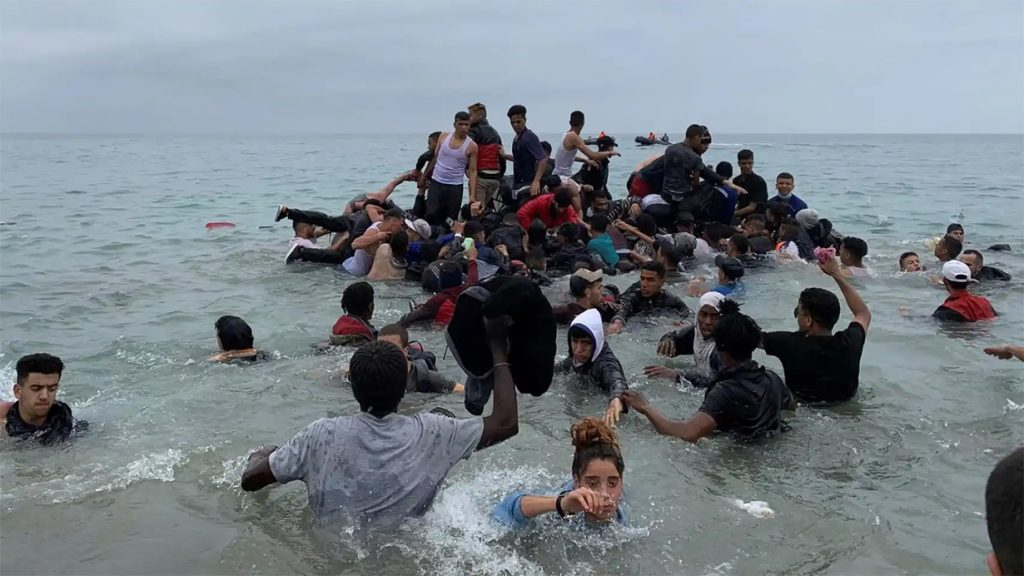
The scene that unfolded on Thursday morning along the waters near Spain’s North African territory of Ceuta was not a scene of people enjoying a day at the beach.
The men, women and children struggling through the sea were not there for recreation. They were fighting against waves, exhaustion and uncertainty, carrying with them a dream that has driven thousands before them — reaching Europe in search of safety, work and a better future.
For many, however, that dream ended in tragedy.
At least 18 migrants died while attempting to reach Ceuta by sea, while hundreds of others were rescued after making the dangerous crossing from Morocco, according to reports from international and Spanish media outlets.
The victims included desperate families, young people and children who risked their lives in one of the most dangerous migration routes into the European Union.
A Sea Route Turned Into a Graveyard of Dreams
Ceuta, a small Spanish autonomous city located on the northern coast of Africa, has long been one of the most sensitive migration points between Africa and Europe.
Although geographically located in Africa, Ceuta is part of Spain and therefore the European Union. Its location makes it one of the few direct land and sea gateways into Europe for migrants coming from Africa.
For years, thousands of people from sub-Saharan Africa and other regions have attempted to enter Europe through Ceuta and nearby Melilla, hoping to escape poverty, conflict, political instability and limited economic opportunities in their home countries.
But the journey is extremely dangerous.
Many migrants attempt to swim across the waters separating Morocco and Ceuta. Others use inflatable tubes, makeshift rafts or small boats. Some try to climb border fences separating Morocco from the Spanish territory.
The latest tragedy has once again highlighted the human cost of Europe’s migration pressures.
Families Among Those Taking the Risk
Videos circulating after the incident showed migrants entering the sea in large groups, carrying only small bags and personal belongings.
Some parents reportedly placed young children on inflatable tubes to keep them above water. Others held their children’s hands while attempting to cross the rough waters.
For many, the journey was not a choice between comfort and hardship.
It was a choice between remaining in difficult circumstances at home or taking a dangerous chance for a different future.
Migration experts say many people who attempt these crossings are aware of the risks but feel they have no alternative.
Thousands Attempted Entry Into Ceuta
Local authorities reported a sharp increase in the number of migrants arriving in Ceuta in recent days.
According to preliminary estimates, more than 1,500 people had reached the territory through maritime routes in the days leading up to the tragedy.
On Thursday alone, officials estimated that several thousand people may have attempted to enter, although exact figures were still being verified.
The sudden arrival of large numbers of migrants overwhelmed local reception facilities.
Many migrants were forced to sleep outdoors as shelters and support centres reached capacity.
Ceuta Calls for Emergency Support
The rapid increase in arrivals created both humanitarian and security challenges for local authorities.
Ceuta’s administration appealed to Spain’s central government for urgent assistance, describing the situation as a humanitarian emergency requiring immediate national support.
Officials warned that local resources were insufficient to manage the sudden increase in arrivals, particularly when many migrants required medical attention, food, shelter and legal processing.
Spain responded by increasing the presence of security forces, emergency workers and rescue teams in the region.
Prime Minister Pedro Sánchez’s government has been closely monitoring the situation, while Interior Minister Fernando Grande-Marlaska has overseen coordination efforts.
Why Are Thousands Choosing This Dangerous Route?
Migration experts say several factors are contributing to the growing pressure on Europe’s borders.
Economic hardship, unemployment, political instability and insecurity in parts of Africa continue to push many people toward Europe.
For many migrants, reaching Spain represents the possibility of accessing better employment opportunities and a more stable life.
However, the journey often involves smugglers, dangerous routes and life-threatening conditions.
Legal Changes Also Influencing Migration Patterns
Analysts have pointed to recent legal developments in Spain as another factor influencing migration movements.
Earlier this month, Spain’s Supreme Court ruled that migrants who reach Ceuta or Melilla by sea cannot simply be immediately returned to Morocco without following required legal procedures.
The ruling reinforced migrants’ right to have their individual circumstances assessed before removal.
Migration experts believe such legal protections may have encouraged more people to attempt the crossing, although they stress that the broader causes of migration are linked to economic, political and humanitarian conditions in migrants’ countries of origin.
Europe’s Continuing Migration Challenge
The Ceuta tragedy has once again revived a difficult debate across Europe — how to balance border security with humanitarian responsibility.
European governments have increased efforts to control irregular migration, strengthen border protection and cooperate with neighbouring countries.
Human rights organisations, however, argue that stronger borders alone cannot solve the crisis and that safer legal migration pathways and international cooperation are needed.
They warn that when legal routes are limited, desperate people often turn to dangerous alternatives.
A Crisis Beyond Borders
The deaths in Ceuta are not only a Spanish border issue. They represent a wider global migration challenge.
Behind every number is a person — a parent, a child, a worker or a young person hoping for a safer future.
The latest tragedy has once again raised the same unanswered question facing Europe:
How can countries protect their borders while also protecting human lives?
For the migrants who entered the waters of Ceuta chasing the European dream, the sea became a place where hope and tragedy met — and for many, the journey ended before their new life could even begin.