

Dhanusha, Nepal — For generations, Dhanushadham has been revered as one of the most sacred pilgrimage sites in Nepal’s Mithila region. Every year, thousands of Hindu devotees travel here to pay homage to the legendary site believed to be connected to Lord Shiva’s divine bow. Today, however, Dhanushadham is gaining recognition for more than its religious significance.
Nestled just a short walk from the famous temple, the Dhanushadham Botanical Garden is quietly transforming into one of Madhesh Province’s most promising eco-tourism destinations. Combining religious heritage, biodiversity conservation, environmental education and tranquil natural surroundings, the garden is attracting pilgrims, researchers, students and nature lovers alike.
Until a few years ago, most visitors came to Dhanushadham solely to offer prayers before returning home. Today, the journey is no longer complete without a walk through the lush botanical garden.
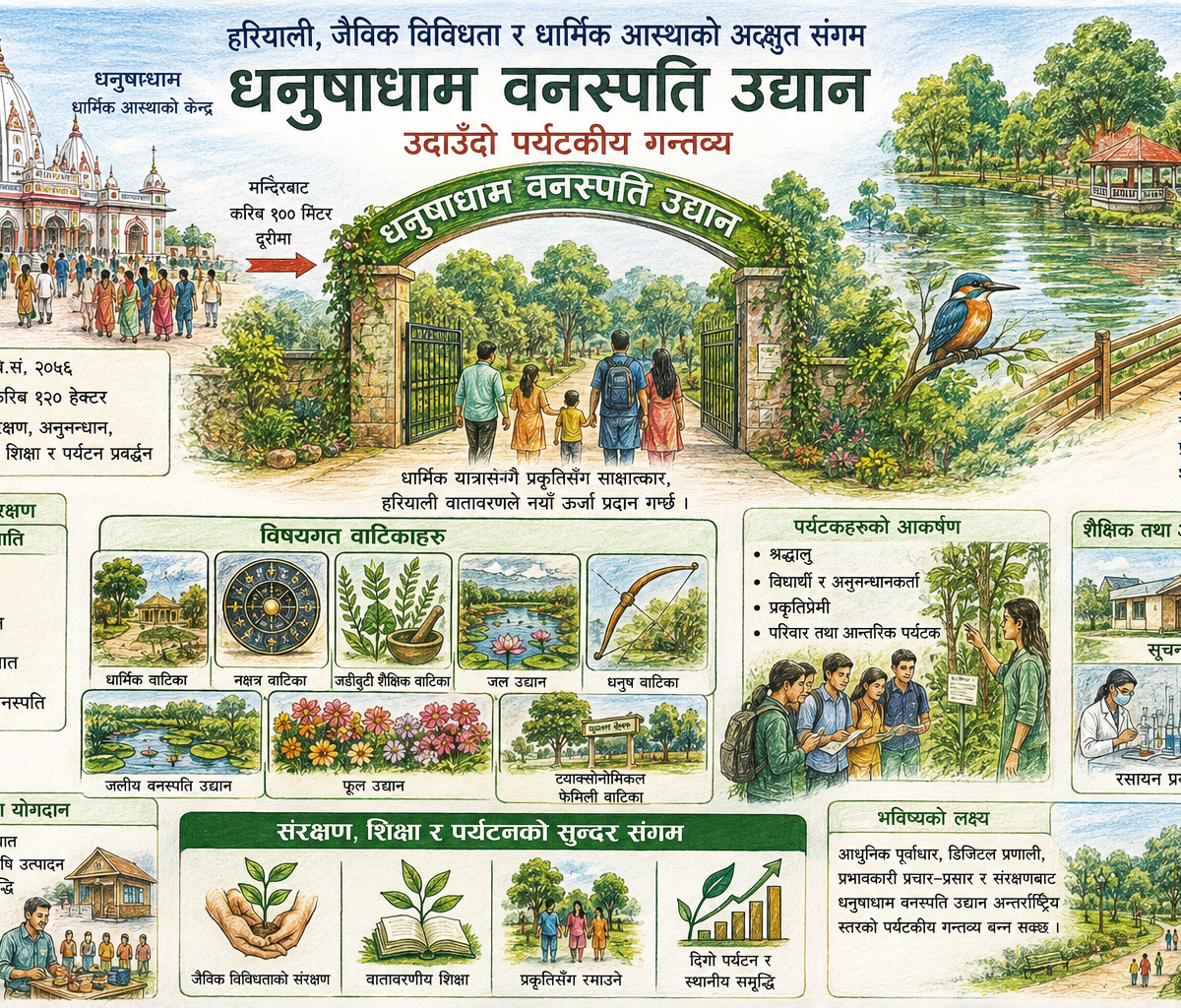
Located about 100 metres from the sacred temple, the garden offers visitors a refreshing escape into nature. Towering trees, colourful flowers, medicinal plants, peaceful walking trails and birdsong create a calm atmosphere that complements the area’s spiritual ambience.
Many pilgrims now choose to spend additional time exploring the garden after visiting the temple, making Dhanushadham a destination where faith and nature coexist harmoniously.
Situated approximately 18 kilometres east of Janakpur, Dhanushadham holds immense religious significance in Hindu mythology.
According to ancient belief, a fragment of Lord Shiva’s divine bow (Dhanush) fell at this location during the Treta Yuga, making it one of Nepal’s most revered pilgrimage sites.
Major Hindu festivals including Vivah Panchami, Ram Navami and Makar Sankranti attract thousands of devotees every year.
Local resident Ramsevak Das says the pattern of tourism has noticeably changed.
“Previously, pilgrims would simply visit the temple and return. Now, most visitors also spend time in the botanical garden, enjoying its natural beauty and peaceful environment.”
Established in 1999 (B.S. 2056) under Nepal’s Ministry of Forests and Environment, the Dhanushadham Botanical Garden was originally created to conserve rare plant species, promote scientific research and provide environmental education.
Today, it has evolved into one of Nepal’s important centres for plant conservation.
Spanning approximately 120 hectares, the garden currently protects 276 plant species, including:
- 74 species of trees
- 48 species of shrubs
- 134 species of herbs
- 20 species of climbing plants
According to garden chief Tahir Hussein, the collection includes rare and endangered plants, medicinal herbs, aquatic vegetation, ornamental flowers, perennial trees, ferns and numerous indigenous plant species preserved using scientific methods.
One of the botanical garden’s most distinctive attractions is its collection of specialised themed gardens, designed for education, conservation and public awareness.
These include:
- Religious Garden
- Nakshatra (Constellation) Garden
- Medicinal Plant Education Garden
- Water Garden
- Dhanush Garden
- Aquatic Plant Garden
- Flower Garden
- Taxonomical Family Garden
The Religious Garden features trees associated with Hindu traditions, while the Nakshatra Garden preserves plants linked to 27 constellations, 12 zodiac signs and nine planetary bodies according to Vedic astrology.
Each plant is accompanied by scientific information, allowing students, researchers and visitors to learn about botany through direct observation.
Beyond tourism, the botanical garden has become an important research facility.
The garden includes an Information Centre and a Chemistry Laboratory, where specialists analyse the essential oil content of aromatic herbs and medicinal plants.
Schools, universities and research institutions regularly organise educational visits, giving students valuable practical experience in plant science, biodiversity conservation and environmental studies.
According to garden staff member Suresh Bhandari, visitor numbers have increased dramatically over the past few years.
“Previously, only around 10 to 20 people visited the garden each day. Today, we receive approximately 300 to 400 visitors daily, including domestic tourists, Indian pilgrims and student groups.”
While entry has remained free until now, authorities say an admission fee is expected to be introduced in the near future.
The growing popularity of social media has significantly increased public awareness of the botanical garden.
Photographs and videos showcasing its greenery, flower gardens, water features and peaceful landscapes have been widely shared online, encouraging more people to visit.
As a result, the garden is no longer attracting only religious pilgrims but also photographers, environmental enthusiasts, families and eco-tourists.
The increase in visitor numbers is beginning to generate new economic opportunities for the surrounding community.
According to Min Bhattarai, Chief Administrative Officer of Dhanushadham Municipality, tourism growth is helping create employment while stimulating local businesses. The municipality has pledged continued support for the garden’s conservation and promotion.
Local youth Santosh Mandal says hotels, restaurants, transportation services, handicraft businesses and agricultural producers are all benefiting from the increase in visitors. More young people are also considering tourism-related careers.
Business owner Shankar Sah notes that accommodation facilities and tourism infrastructure have gradually expanded as visitor numbers continue to grow.
Local stakeholders believe the botanical garden has enormous potential to become a nationally and internationally recognised eco-tourism destination.
Future improvements being proposed include:
- Modern visitor information centres
- Digital guide systems
- Nature interpretation centres
- Cycling tracks
- Nature walking trails
- Children’s botanical park
- Expanded research laboratories
- Improved tourist facilities
These developments could significantly strengthen Dhanushadham’s position as one of Nepal’s leading destinations for sustainable tourism.
As global demand for nature-based and sustainable tourism continues to rise, Dhanushadham Botanical Garden offers a unique combination of religious heritage, biodiversity conservation, environmental education and natural beauty in a single destination.
Visitors leave with far more than photographs of green landscapes. They take home a deeper appreciation for nature, greater awareness of environmental conservation and a desire to return.
By successfully bringing together pilgrimage tourism and eco-tourism, Dhanushadham Botanical Garden is emerging not only as one of Madhesh Province’s most attractive destinations but also as one of Nepal’s rising green tourism treasures.