
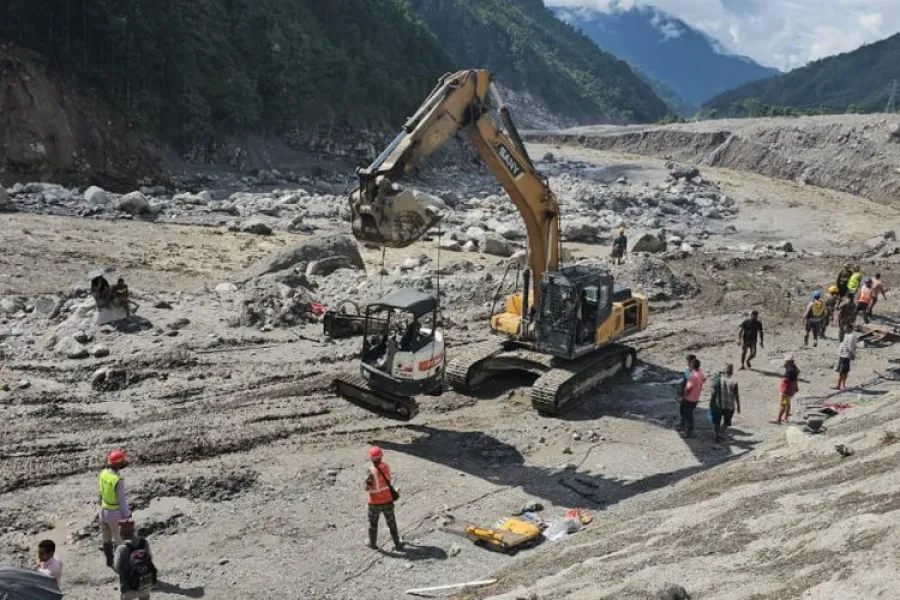
Kathmandu — A preliminary assessment carried out under the Rapid Damage and Needs Assessment (RDNA) has found that at least 32,933 people were affected by the devastating flood in the Bhotekoshi River on August 26. According to the Ministry of Foreign Affairs (MoFA), the flood damaged or affected approximately 7,570 houses across the affected areas.
The disaster also caused extensive damage to transport infrastructure, destroying or damaging around 55 kilometres of roads, 37 motorable bridges and 68 suspension bridges. The Department of Roads had earlier estimated that damage to roads and motorable bridges alone amounted to around Rs. 20 billion.
The floods, described as a “Himalayan Tsunami”, also damaged approximately 1,806 hectares of agricultural land, 13 hydropower projects, one solar power plant and two transmission lines.
The preliminary assessment shows that around 783 megawatts of hydropower generation capacity has been affected.
However, the full assessment has yet to be completed. The National Disaster Risk Reduction and Management Authority (NDRRMA) said an expert team is working to finalise the report, which is expected to be ready by Sunday.
The Foreign Ministry said a comprehensive Post Disaster Needs Assessment (PDNA) is also being undertaken to determine the full scale of losses and damage, as well as the resources required for rebuilding and reconstruction.
Efforts Underway to Restore Connectivity
Authorities are continuing efforts to restore road, electricity and telecommunications services in the affected areas while ensuring that relief supplies reach affected communities as quickly as possible.
The Nepali Army, supported by a team of engineers, is working to restore the Galchhi–Trishuli Road by constructing a temporary bridge over the Tadi River.
Two cable pulley systems have also been brought into operation, one at Trishuli Indrenighat and another at Devighat, to support transportation and movement in the affected areas.
International Rescue Teams Join Operations
International assistance has also been mobilised for the search and rescue operations.
A 15-member Disaster Assistance and Response Team (DART) from Australia arrived in Nepal on Friday, while an 11-member Special Malaysian Disaster Assistance and Rescue Team (SMART) arrived on Saturday morning.
Tunnel rescue teams from India, China and the Republic of Korea are continuing to work alongside Nepali security agencies.
Rescue equipment, drones, load carriers and other materials provided by neighbouring countries, friendly nations and the international community are being used in the ongoing operations.
Additional equipment and technical personnel are also being deployed to continue search and rescue operations at affected hydropower projects, including Upper Trishuli 1, Upper Trishuli 3A, Upper Trishuli 3B, U216 Haku, Chilime and Langtang, among others.
Nepalis Stranded in Tibet Return Home
Meanwhile, 127 Nepali nationals who were stranded or affected in Tibet following the disaster returned to Nepal through the Tatopani border point on Saturday, according to the Ministry of Foreign Affairs.
A further 155 Nepalis returned through Tatopani on Friday.
Earlier, groups of Nepali nationals were also brought back to Nepal through the Korala border point following coordination between Nepali diplomatic missions in China and Chinese authorities.
The Rasuwagadhi–Kerung border crossing has been completely swept away by the floods, prompting tourists and pilgrims stranded in Tibet to use the Tatopani route to return to Nepal.