
Nepal: The Rastriya Swatantra Party (RSP) has concluded its second national convention by electing a new leadership team, but the event was overshadowed by organizational failures, internal factionalism, and growing concerns over the party’s commitment to internal democracy.
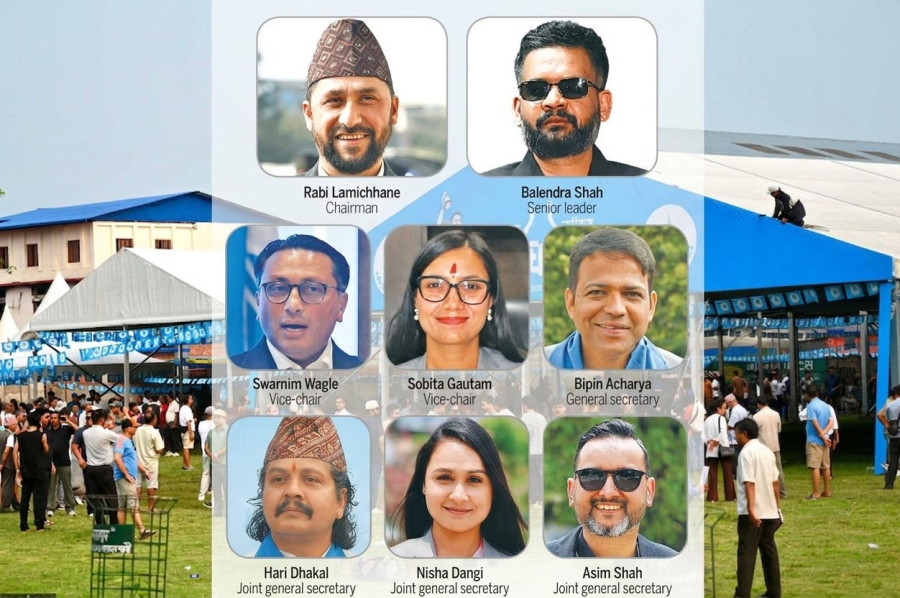
Party President Rabi Lamichhane and Vice-President Dr. Swarnim Wagle were elected unopposed, while the closely watched elections for other key positions produced competitive outcomes. Sobita Gautam secured the vice-president position with 789 votes, defeating Toshima Karki, who received 572 votes.
In the race for General Secretary, Bipin Acharya emerged victorious with 673 votes, comfortably ahead of former party spokesperson Manish Jha (346 votes), Ganesh Karki (169 votes), and Sagar Dhakal (139 votes).
The convention also elected Asim Shah and Hari Dhakal as open Joint General Secretaries, while Nisha Dangi won the women’s reserved Joint General Secretary position after defeating four other candidates.
Convention Extended by Delays and Confusion
Originally scheduled as a three-day event, the convention stretched to six days due to repeated delays, logistical shortcomings, and procedural confusion.
The prolonged schedule led to a significant drop in delegate participation. Although more than 4,000 delegates were expected to attend, only 1,289 delegates remained to vote for the party’s executive leadership. Earlier central committee elections had attracted nearly 3,000 voters, highlighting the impact of the delays.
Delegates complained about poor accommodation arrangements, lengthy registration queues, technical issues with electronic voting machines (EVMs), and repeated changes to the convention schedule. Several participants left Chitwan before the final round of voting, forcing the leadership election to be decided by less than half of the original delegates.
Consensus Efforts Expose Internal Grouping
The election for General Secretary became the convention’s most competitive contest.
Senior leaders attempted to avoid a divisive election by encouraging candidates to withdraw in favour of consensus. Several contenders, including Kabindra Burlakoti, Pramod Neupane, Ganesh Parajuli, and Jagdish Kharel, eventually withdrew and publicly endorsed Bipin Acharya. Foreign Minister Shisir Khanal also backed Acharya’s candidacy.
However, references to an “establishment camp” during the withdrawal announcement sparked criticism within the party, exposing internal factional alignments that RSP leaders had long claimed did not exist.
Former spokesperson Manish Jha questioned the process, arguing that genuine consensus should not come through pressure on candidates to withdraw and warning that such practices contradicted the party’s founding principles.
Following his victory, Acharya sought to ease tensions, stating that every delegate and leader represented the party’s establishment and that no group should feel excluded.
WhatsApp Leak Raises Fresh Concerns
The convention also faced controversy after a leaked WhatsApp message containing a list of 56 preferred central committee candidates circulated among delegates during voting.
The anonymous list immediately raised concerns about attempts to influence the election outcome. Several party leaders called for an internal investigation, warning that such practices resembled the factional politics the RSP had pledged to replace.
Candidates also reported confusion over the numbering system used on electronic voting machines, saying it complicated the voting process.
Party Expands Leadership Structure
Following recent amendments to its statute, the RSP expanded its executive committee from 12 to 19 positions. Party insiders say the additional nominated posts are intended to provide broader representation and accommodate leaders who recently joined the party.
Several prominent leaders from Prime Minister Balendra Shah’s political camp chose not to contest the central committee elections, with expectations that some may be appointed to nominated positions.
RSP Adopts Social Democracy as Official Ideology
Despite the organisational challenges, the convention approved a significant ideological shift.
Chairman Rabi Lamichhane announced that the party would now officially adopt “Social Democracy” as its guiding political philosophy, replacing its earlier concept of “Constitutional Socialism.”
Lamichhane said the change reflects the party’s belief that Nepal’s Constitution should remain a living and evolving document rather than a fixed ideological framework.
The convention also endorsed proposals to transform the National Assembly into a non-partisan chamber of experts, appoint the Vice-President as its ex-officio chair, and support the direct election of the country’s executive head.
Reformist Image Faces Test
Political observers say the convention highlighted the gap between the RSP’s reform-oriented image and its organisational capacity.
Poor event management, administrative errors, questions over transparency, and visible internal factionalism drew criticism from delegates and analysts alike.
Following his re-election, Lamichhane acknowledged the shortcomings, attributing them to the party’s relative inexperience and promising to improve the organisation of future conventions.
While the RSP has successfully elected a new leadership team and adopted a revised ideological direction, the convention also exposed internal challenges that the party will need to address as it seeks to strengthen its credibility as Nepal’s leading alternative political force.