
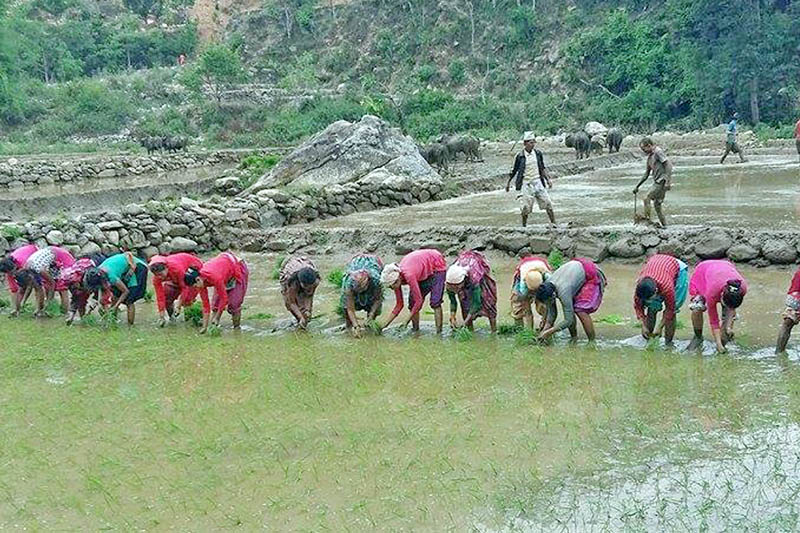
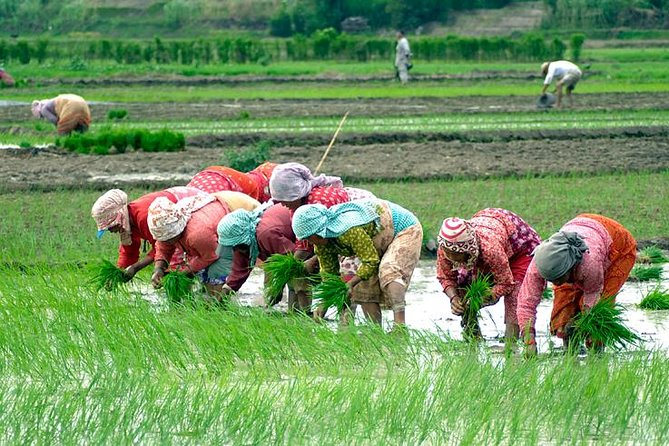
Kathmandu: As Nepal celebrates National Rice Day on June 29 with the slogan “Climate-Friendly Technology, Self-Reliance in Rice, and Prosperity,” farmers across the country are busy transplanting rice seedlings into waterlogged fields. Traditional Asare songs echo through villages, government officials join symbolic plantation events, and social media fills with images of muddy celebrations.
Yet beneath the festive atmosphere lies a contradiction that continues to challenge Nepal’s agricultural ambitions: while the nation repeatedly pledges self-reliance in rice production, it still depends heavily on imported rice seeds.
According to the Department of Customs, Nepal imported nearly 2,993 tonnes of rice seed worth Rs 1.29 billion during the first 11 months of the current fiscal year 2025/26—an increase of around 11 percent compared to the same period last year. Almost all of these imports came from India and China, highlighting the country’s continued reliance on foreign seed suppliers.
Ironically, the Ministry of Agriculture and Livestock Development maintains that Nepal produces enough rice seed domestically. The country requires approximately 71,000 tonnes of rice seed annually, while domestic production ranges between 70,000 and 78,000 tonnes.
However, experts say the issue is not the overall quantity of seed, but the type of seed farmers prefer.
According to Dr. Mathur Yadav, Coordinator of the National Rice Research Programme, nearly 90 percent of imported rice seeds are hybrid varieties. Although Nepal has developed more than 150 improved rice varieties, only two hybrid varieties have been produced domestically, leaving farmers with limited local options.
Nepal’s seed system also remains largely informal. Nearly 77 percent of farmers still save seeds from previous harvests, exchange them with neighbours, or purchase them through local markets rather than using certified seeds.
Dr. Prakash Acharya, Senior Crop Development Officer at the Seed Quality Control Centre, says farmers increasingly demand high-yield hybrid seeds, but domestic production cannot meet market needs.
“Without greater investment in research, hybrid seed development, and commercial production, Nepal will continue to rely on imported seeds,” he said.
The Nepal Agricultural Research Council (NARC), responsible for producing foundation seeds, also acknowledges its limited capacity. Government farms produce only around 200 tonnes of foundation seed each year, far below national requirements. Officials also note that many farmers bring seeds informally across the open border with India, making the actual volume of imported seed even higher than official figures suggest.
In recent years, private companies in Koshi, Madhesh, Lumbini and Sudurpashchim provinces have increased investment in improved rice seed production. Agricultural experts believe stronger collaboration among the government, research institutions and the private sector could significantly reduce Nepal’s dependence on foreign seeds within a few years.
Rice remains the backbone of Nepal’s food security, rural economy and the livelihoods of millions of farming families. True self-reliance, experts argue, is not achieved simply by increasing rice production—it also requires developing, producing and supplying quality seeds within the country.
As farmers celebrate Rice Day with enthusiasm and hope for a good harvest, the seeds in their hands tell a different story. Until Nepali farmers can confidently plant high-quality seeds produced at home, the country’s vision of rice self-sufficiency will remain an aspiration rather than a reality.